
As a business grows, customer communication often becomes one of the first areas to feel stretched.
More inquiries come in. Follow-ups take longer. Emails sit unanswered. Missed calls turn into missed opportunities. Customers expect faster responses, but the owner or internal team may already be busy handling operations, marketing, admin work, project delivery, and daily coordination.
At that stage, many business owners start comparing customer service outsourcing vs in-house support.
Should you hire someone internally? Should you build a customer support team from scratch? Or should you work with an outsourced customer service partner that can help manage communication, follow-ups, and daily support tasks?
There is no one-size-fits-all answer. The right choice depends on your business size, workload, budget, systems, response needs, and growth stage.
This guide explains the difference between outsourced customer service and in-house customer support, the pros and cons of each, and how to decide which support model makes sense for your business.
What Is In-House Customer Support?
In-house customer support means your customer service team is employed directly by your business.
This could be:
- A full-time customer service representative
- A receptionist or front desk coordinator
- An internal admin assistant
- A sales support coordinator
- A customer success team
- A small internal support department
With in-house customer support, your business manages hiring, training, payroll, supervision, systems, scheduling, and performance directly.
This model can work well when customer communication is highly specialized, sensitive, location-based, or deeply tied to your internal operations.
For example, a medical office, legal practice, construction company, design studio, or service business may eventually need internal team members who understand the business very closely.
However, building an in-house team can take time. It also requires management capacity, training, clear processes, and ongoing payroll costs.
What Is Customer Service Outsourcing?
Customer service outsourcing means a business works with an external support partner to help manage customer communication and support tasks.
This may include help with:
- Responding to customer emails
- Answering inquiries
- Managing live chat
- Handling basic customer support tickets
- Following up with leads or clients
- Updating CRM records
- Scheduling calls or appointments
- Sending reminders
- Organizing support requests
- Escalating important issues to the business owner or internal team
Outsourced customer service can be part of a broader BPO support model. BPO stands for business process outsourcing, which means delegating certain business processes to an outside support provider.
For small businesses, BPO support does not always mean a huge call center or corporate operation. It can also mean having a reliable outsourced support team that helps keep daily communication and follow-up work organized.
The goal is not just to “answer messages.” The goal is to help customers get timely responses, reduce missed follow-ups, and keep business operations moving more smoothly.
Customer Service Outsourcing vs. In-House Support: The Main Difference
The main difference comes down to how the support is built and managed.
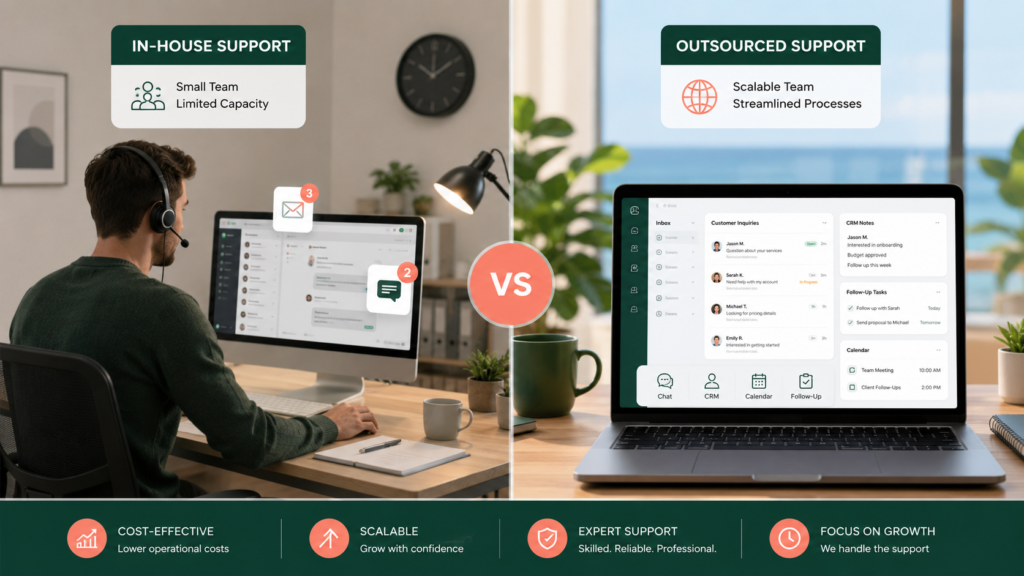
With in-house customer support, you hire and manage the team directly.
With outsourced customer service, you work with an external partner that provides support capacity, structure, and execution based on your business needs.
Both models can work. The better option depends on your current stage.
In-house support gives you more direct control
An internal employee is part of your company day to day. They may have deeper access to internal context, team discussions, customer history, and company culture.
This can be helpful when support requires quick judgment, complex decision-making, or frequent coordination with multiple departments.
Outsourced support gives you more flexibility
Outsourced support can help when you need extra capacity without immediately building a larger internal team.
For example, a small business may not be ready to hire a full-time customer service employee, but still needs help responding to inquiries, organizing follow-ups, and managing customer communication during business hours.
This is where outsourced customer service can be useful.
Pros of In-House Customer Support
In-house support has real advantages, especially for businesses with complex customer needs.
1. Direct team integration
An in-house support person is part of your daily team. They can join meetings, understand internal priorities, and learn your company culture closely.
This can be useful if customer support requires constant communication with sales, operations, project managers, or leadership.
2. Stronger control over training
When you manage support internally, you control the training process directly.
You decide how customers should be greeted, what tone to use, how issues should be handled, and when to escalate problems.
3. Easier access to internal knowledge
Some customer questions require detailed company knowledge. An internal employee may understand your services, policies, clients, and operations more deeply over time.
4. Good fit for high-touch businesses
Some service businesses need very personalized support. If every customer conversation requires careful judgment, an in-house team may be the better long-term option.
Cons of In-House Customer Support
In-house support can be valuable, but it also comes with challenges.
1. Higher fixed costs
Hiring in-house often includes salary, taxes, benefits, equipment, training time, software access, and management overhead.
For a growing small business, this may be a big commitment before the workload is stable enough to justify it.
2. Slower hiring process
Finding the right person takes time. You may need to write a job post, review applicants, interview candidates, check references, onboard the employee, and train them.
During that time, customer messages may still be piling up.
3. Limited coverage
One in-house employee can only handle so much. If they are unavailable, on vacation, sick, or overloaded, your business may still struggle with response times.
4. More management responsibility
Hiring someone internally does not automatically solve the problem. You still need processes, systems, expectations, quality checks, and clear workflows.
Without structure, customer support can still become messy.
Pros of Customer Service Outsourcing
Customer service outsourcing can be a practical option for businesses that need support capacity but are not ready to build a full internal team.
1. Faster support capacity
Outsourced customer service can help you add support without starting from zero.
This can be helpful when your business is getting more inquiries, leads, appointments, customer requests, or follow-up tasks than your current team can manage.
2. Lower hiring burden
Instead of managing the entire hiring and onboarding process alone, you can work with an outsourcing partner that helps provide support based on your needs.
This can reduce the time and effort involved in building support capacity.
3. Better organization around follow-ups
Many small businesses do not lose opportunities because they lack demand. They lose opportunities because follow-ups are inconsistent.
Outsourced customer service can help with:
- Responding to inquiries
- Logging customer details
- Updating CRM notes
- Sending reminders
- Following up after calls
- Tracking pending replies
- Escalating urgent messages
This helps keep customer communication from falling through the cracks.
4. Flexible support as the business grows
Outsourced support can be useful when your needs are growing but not yet predictable enough for a large in-house team.
For example, you may need help with customer emails, scheduling, CRM updates, and lead follow-ups now, then later expand into customer service, admin support, or digital marketing support.
5. Support beyond customer service
A good outsourcing partner can often support connected tasks too.
Customer communication is usually tied to other business processes, such as:
- Admin work
- Appointment scheduling
- Lead management
- CRM updates
- Marketing follow-up
- Website inquiries
- Project coordination
- Reporting
This is why BPO support can be helpful for growing businesses. It allows support to connect with the daily operations behind the customer experience.
Cons of Customer Service Outsourcing
Customer service outsourcing can work well, but it needs to be set up properly.
1. You need clear processes
Outsourced support works best when your business has clear instructions, response guidelines, escalation rules, and access to the right tools.
If nothing is documented, the first step may be organizing your workflows before handing off support tasks.
2. Not every task should be outsourced immediately
Some customer conversations may require the owner, a manager, or an internal expert.
For example, complex complaints, pricing exceptions, legal questions, technical issues, or sensitive client situations may need to stay internal.
A good outsourced support setup should include escalation rules so the support team knows when to pass something to you.
3. Quality depends on the partner
Not every outsourcing provider works the same way.
Some focus on volume. Some focus only on call handling. Some operate like freelancer marketplaces. Others provide more organized, managed support.
For a service business, it is important to choose a support partner that understands workflows, communication standards, and daily business operations.
Practical Examples for Small Businesses
Customer service outsourcing vs in-house support becomes easier to understand when you look at real business situations.
Example 1: Interior design studio
An interior design studio may receive inquiries through its website, Instagram, email, and referral partners.
The owner may be busy with client meetings, vendor coordination, site visits, and design work.
Outsourced support could help with:
- Replying to new inquiries
- Organizing consultation requests
- Sending intake forms
- Scheduling discovery calls
- Updating the CRM
- Following up with leads who have not responded
The designer still handles the creative and client-facing strategy, but support helps keep communication organized.
Example 2: Cleaning business
A cleaning company may deal with quote requests, rescheduling, customer questions, complaints, and recurring service reminders.
Outsourced customer service could help with:
- Responding to service inquiries
- Confirming bookings
- Updating customer records
- Sending follow-up messages
- Tracking missed calls or emails
- Escalating urgent customer concerns
This can help the business respond faster without the owner handling every message personally.
Example 3: Landscaping company
A landscaping business may have seasonal peaks where inquiries, estimates, and scheduling requests increase quickly.
Outsourced support could help during busy seasons by:
- Organizing new leads
- Following up on estimate requests
- Updating appointment details
- Sending reminders
- Managing basic customer questions
- Keeping CRM records current
This gives the business more support capacity during high-demand periods.
Example 4: Small agency or service provider
A small agency may need help managing client communication, support requests, website tickets, marketing tasks, or project follow-ups.
Outsourced support could help with:
- Client inbox management
- Ticket organization
- CRM updates
- Project follow-up reminders
- Reporting support
- Scheduling client calls
The internal team can focus on strategy and delivery while support handles routine coordination.
When In-House Support May Be the Better Fit
In-house customer support may be better when:
- Your customer conversations are highly complex
- You need someone physically present
- Support requires deep internal decision-making
- You have enough steady workload for a full-time employee
- You have time and capacity to hire, train, and manage directly
- Customer support is central to your company culture and brand experience
- You want one person fully embedded in your internal team
For some businesses, in-house support is the right long-term move. Outsourcing does not have to replace internal hiring. It can also support the business until an internal team is ready.
When Customer Service Outsourcing May Be the Better Fit
Customer service outsourcing may be a better fit when:
- You are missing calls, emails, chats, or follow-ups
- The owner is still handling too much daily communication
- You need help but are not ready for a full in-house team
- Your leads or customers need faster responses
- Your CRM is not being updated consistently
- Customer questions are slowing down your team
- You want support for admin and operations alongside customer service
- You need more organized workflows before scaling your team
Outsourced customer service can be especially helpful for growing service businesses that need structure, consistency, and support capacity without immediately adding multiple internal hires.
What Tasks Can Be Handled by Outsourced Customer Service?
The right tasks depend on your business, but common customer support options include:
Inquiry management
Support can help respond to new inquiries from your website, email, forms, social media, or CRM.
Customer follow-ups
This may include following up after consultations, estimates, service requests, missed calls, or incomplete forms.
Appointment scheduling
Support can help coordinate calendars, send reminders, and reduce back-and-forth communication.
CRM updates
A support team can help keep customer records, notes, statuses, and follow-up dates organized.
Basic customer questions
Support can answer common questions using approved scripts, FAQs, and business guidelines.
Escalation support
Not every issue should be handled by outsourced support. A clear escalation process helps important questions reach the right internal person.
What Should Stay In-House?
Even with outsourced customer service, some tasks may be better handled internally.
These may include:
- Final pricing decisions
- Complex customer complaints
- Sensitive account issues
- Legal or financial decisions
- Custom proposals
- High-level client strategy
- Specialized technical decisions
- Relationship management for key accounts
A strong support setup clearly defines what the outsourced team can handle and what should be escalated.
How to Decide Between Outsourced and In-House Support
Before choosing, ask yourself these questions.
1. How much support volume do we have?
If you only have a small number of customer messages each week, you may not need a full-time hire.
If your inbox, CRM, calls, and follow-ups are becoming hard to manage, outsourced support may help you create structure first.
2. Are we missing opportunities because of slow responses?
If leads or customers wait too long for replies, your business may need better support coverage.
3. Do we have clear processes?
If your processes are not clear, you may need help organizing workflows before adding support.
This includes:
- Response templates
- Escalation rules
- CRM stages
- Follow-up steps
- Customer FAQs
- Scheduling instructions
4. Do we need one person or a support system?
Sometimes the issue is not just a lack of people. It is a lack of structure.
A support system may include people, workflows, tools, templates, and reporting.
5. What can we delegate safely?
Start with repeatable tasks. Keep sensitive or high-level decisions internal until the support team is trained and trusted.
When to Consider Outsourced Support
You may be ready to consider outsourced support if your business is experiencing any of these signs:
- You are responding to customers late at night
- Leads are not being followed up consistently
- Customers ask the same questions repeatedly
- Your CRM is outdated or incomplete
- Admin work is slowing down customer response time
- Your team is busy but daily tasks still fall behind
- You want to improve organization before hiring more internally
- You need help across customer service, admin, operations, and follow-ups
- Your business is growing, but your support systems have not caught up
Outsourcing can be a practical middle step between doing everything yourself and building a large in-house team.
How StaffShore Can Help
StaffShore helps growing businesses build reliable outsourced support for customer service, admin, operations, digital marketing, website, development, CRM, and follow-up tasks.
StaffShore is not a freelancer marketplace or a quick gig platform. The focus is on organized outsourced support that helps your business stay responsive and keep daily work moving.
Depending on your needs, StaffShore can help with:
- Customer inquiry support
- Email and inbox support
- Lead follow-up
- CRM updates
- Appointment scheduling
- Admin and operations support
- Customer communication workflows
- Website and digital support
- Marketing task support
- Development and technical support coordination
The goal is to help you build support capacity with clearer workflows, better task organization, and more consistent follow-through.
For many small businesses, customer service is not separate from operations. A customer inquiry may lead to a quote, a follow-up, a calendar invite, a CRM update, a marketing touchpoint, or a website form issue.
StaffShore helps connect those pieces so your support does not feel scattered.
Customer Service Outsourcing vs. In-House Support: Which Is Right for You?
If your business needs deep internal knowledge, constant judgment, or highly specialized customer interactions, in-house customer support may be the better fit.
If your business needs more capacity, faster responses, better follow-up, and organized daily support without immediately hiring a large internal team, customer service outsourcing may be worth considering.
Many businesses eventually use both.
For example, you may have an internal manager who handles complex customer issues while an outsourced support team manages routine inquiries, CRM updates, scheduling, and follow-ups.
That hybrid approach can help your business stay flexible while still keeping important decisions close to your internal team.
Conclusion
Choosing between customer service outsourcing and in-house customer support is not just a cost decision. It is an operations decision.
You need to think about response time, customer experience, team capacity, workflow organization, and how much support your business really needs right now.
In-house support gives you direct control and deeper internal integration. Outsourced customer service gives you flexibility, added capacity, and help with daily communication and follow-up tasks.
For many growing service businesses, outsourcing can be a practical way to stay organized before building a larger in-house team.
If your business is missing follow-ups, struggling to respond quickly, or feeling stretched across customer service and daily operations, StaffShore can help you explore a more organized support model.
To learn more, visit StaffShore or schedule a call to discuss what kind of outsourced support would fit your business.